
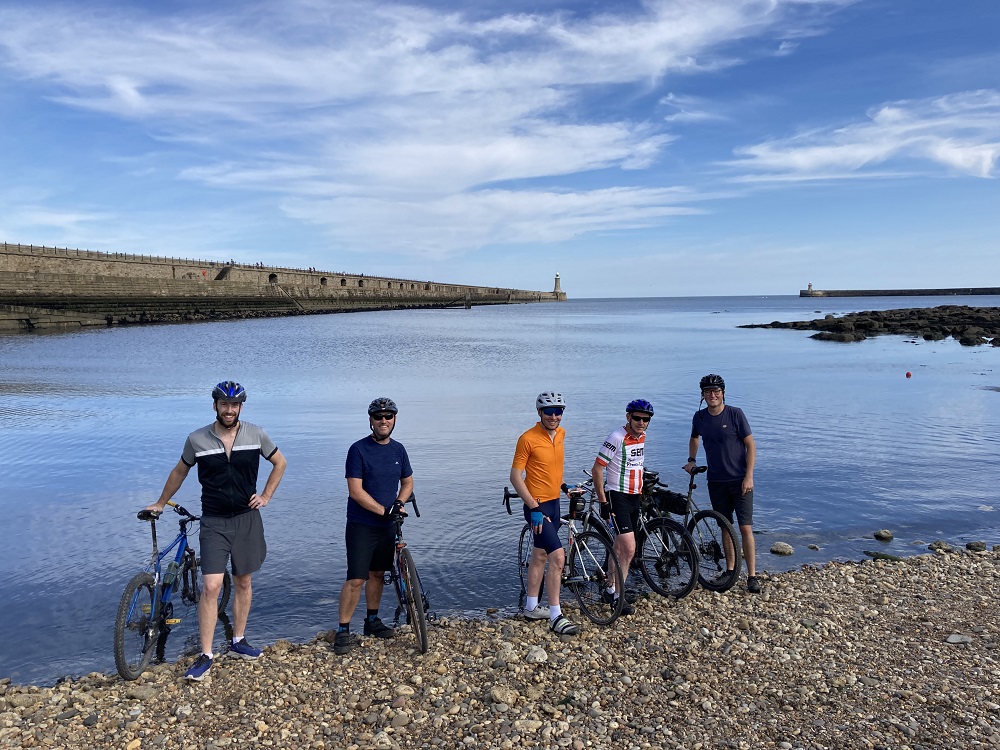
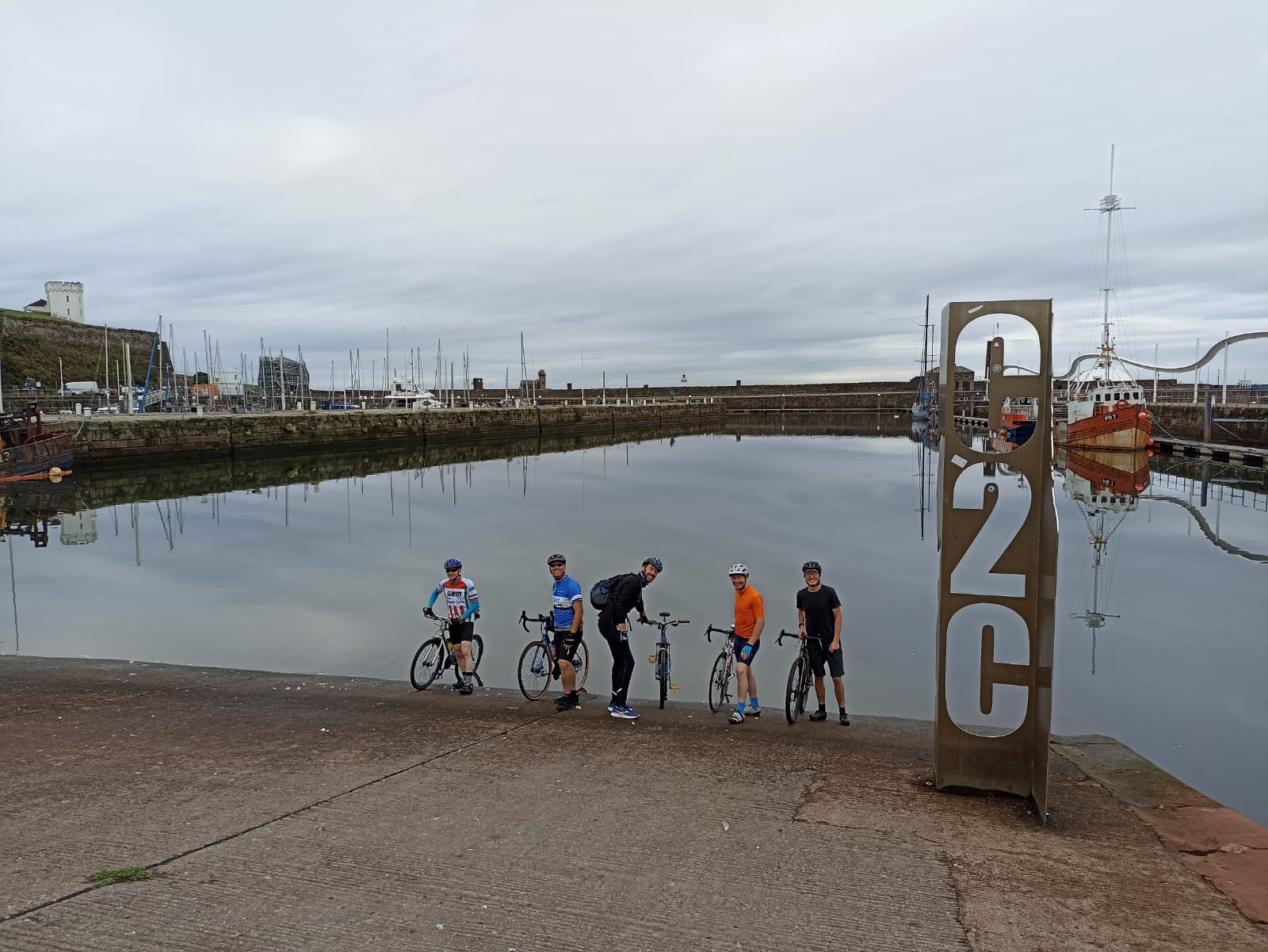
On Friday 1st September 2023, five members of Pearson Engineering set off on the Coast to Coast (C2C) cycle route, starting from Whitehaven in Cumbria and finishing the three-day route in Tynemouth on the Sunday.
The team were raising donations for a local North East Children’s Charity, Heel & Toe, who provide a range of therapies to children with physical disabilities and complex needs. Adam from Pearson Engineering who organised the ride, chose Heel & Toe as the therapies that they offer have benefited those closest to him. Heel & Toe is a local charity that are doing brilliant work across the region.

Starting at Pearson Engineering early Friday morning the team were escorted across to Whitehaven to begin the ride. They then cycled approximately 54 miles from Whitehaven to Penrith. After an early evening, they set off on the most testing day out of the three, for the 47 miles from Penrith to Eastgate with most of the ride challenging their legs on the uphill route. The highlight for day two was reaching Hartside Summit at an altitude of 1,903 feet. The final stretch of the ride was easier on the legs starting from Eastgate and cycling around 38 miles to finish in the coastal town of Tynemouth in the North East of England.
Throughout the three-day challenge, the team were supported by the wife of one of our colleagues who kindly offered to be the support driver; thankfully she didn’t need to escort any of the bikes apart from across to Whitehaven ready for the first day!
Adam and the team added, “We couldn’t have asked for better weather and a better group to complete the ride. We all supported each other through the tough climbs, especially the unexpected 1km uphill ride to the bunkhouse at the end of the second day. The added bonus for us all was reaching the pub at the end of each day for good food, good beer, and brilliant company. We also enjoyed the moral support from members of the Pearson Engineering team, who took the time to come and meet us throughout the route on day one and day two!”
The final donations raised are still ongoing as the team are continuing their fundraising efforts for Heel & Toe with an office bake sale and quiz. We will update this article with the final donations raised once collections are closed.
If you would like to make a donation, please contact us here.
From everyone here at Pearson Engineering, well done to all of the team who completed the challenge to raise donations for a fantastic local North East Children’s Charity.
Our battle proven minefield breaching products provide armoured vehicles with the capability to defeat anti-tank mines. Whether intended for deliberate breaching or to support ‘freedom of manoeuvre’ for fighting vehicles, our blast-resistant ploughs give Commanders the option to move unimpeded and in doing so, maintain a battlefield advantage.
Our earth loading capability delivers a powerful digging and carrying ability, enabling armoured vehicles to transport materials, clear obstacles, dig and fill trenches and to assist in construction tasks. Our loaders can be provided with varying degrees of function and therefore complexity to support different mission sets.
Our interrogation capability is rooted in providing additional capability for Counter-IED and Route Proving operations. To supplement physical detection from ground engaging roller systems, our interrogation arm can be used to further understand the nature of threats and to identify where risks may be present outside of the path of the roller.
Our obstacle and earth moving products include general purpose and multi-purpose dozer blades, designed specifically to meet the needs of different mission sets. Our blades are designed to be tough, robust and lightweight, enabling a wide range of obstacle and earth moving activities whilst minimising the impact on the vehicle’s mobility.
Typically used alongside Pearson Engineering’s Route Opening Mine Plough, Surface Clearance Device or Route Proving rollers, our highly configurable obstacle marking systems support battlefield mobility by quickly and reliably marking safe lanes and the edge of hazardous areas.
Our excavation capability is designed to support combat engineer operations such as digging, demolishing, removing obstacles and filling trenches to support Area Access and Area Denial.
Our approach is often described as a ‘Swiss Army Knife’ in that host vehicles can be adapted to take on various combat engineering roles, or to overcome challenges to mobility. Integration of our products with the vehicle is made via a Pearson Engineering Direct Fit Interface or Pearson Engineering Quick Connect. The most suitable integration method depends on the mission requirements and vehicle capabilities. Our engineers will work closely with end-users and vehicle manufacturers to define the most appropriate route to minimise the impact on the vehicle and to maximise operational capability. Decisions are often based on hydraulic and electrical availability as well as the required role of the vehicle. Our integration kits are used to fit products that are designed to enhance armoured vehicle agility, tactical flexibility and adaptability. They are designed to be configurable and to deliver ‘freedom of manoeuvre’ to operations.
Our recovery capability includes a range of dedicated and multi-purpose blades which are primarily designed to support the recovery of other vehicles and for moving of heavy obstacles. A powerful ground-engaging blade sinks into the earth to hold a vehicle static, acting as the force against which the obstacle can be pulled. The same blade can be articulated to provide some obstacle and earth moving capability.
Surface laid mines represent a rising threat as Armed Forces turn their attention to near peer conflict. Our solutions, each designed to support the missions of dedicated combat engineer vehicles or fighting vehicles, provide a comprehensive detect and displace capability to support deliberate clearance or self-extraction in the face of air delivered scatterable mines.
Our highly configurable rollers have saved countless lives, limbs and assets on operations in Iraq and Afghanistan and have succeeded in ensuring ‘freedom of manoeuvre’ for soldiers around the world. Provided as either a full-width ‘route proving’ variant to actively check routes for the presence of Improvised Explosive Devices, or as a track-width ‘self-protection’ variant, our rollers are designed specifically to meet the needs of wide-ranging operational requirements. Our continued Research & Development and our approach to customisation provides confidence to those who use them.
Like all of Pearson Engineering’s products, our assault gap crossing solutions are designed to be modular, to be interchangeable with other mobility and counter-mobility equipment and to support ‘freedom of manoeuvre’ on the battlefield. In a time when units are tasked to ‘march divided and fight united’, independent manoeuvre support is key.
Our range of Mine Clearance platforms and tools provide Armed Forces and other organisations with scalable solutions for mine clearance, explosive ordnance disposal and the defeat of improvised explosive devices. Our platforms and their tools can also be used to create mobility challenges for adversaries. Proven around the world, these mine clearance platforms and their tools are designed specifically to meet the needs of different operational contexts from large area clearance to support logistics and peace keeping operations through to clearance in complex terrain.